
Do you see me? The unseen journey of an invisible traveller
What does it mean to travel through a world that doesn't fully see you? In this Learning Disability Week reflection, Nora explores the hidden realities of travelling with an invisible condition, the unseen effort required to navigate unfamiliar spaces, and why lived experience must be at the heart of accessibility and inclusion.
Nora Selina Helal
6/19/20264 min read

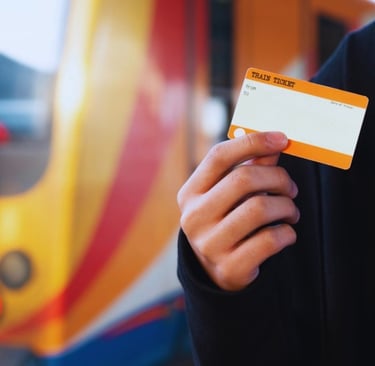
Do you see me?
It is a simple, deceptively quiet question. Yet, as the international community observes Learning Disability Week, this question carries a profound weight for millions of people navigating the world with a hidden condition.
According to data compiled in the landmark World Health Organisation (WHO) Global Report on Health Equity, an estimated 1.3 billion people live with some form of disability worldwide. Crucially, an authoritative UK Parliament Research Briefing on Invisible Disabilities reveals that up to 80% of these disabilities are entirely hidden from plain sight —encompassing neurodivergent conditions like autism and ADHD to chronic fatigue and mental health challenges.
When we step into a bustling airport terminal, a grand hotel lobby, or onto a crowded train platform, we are asking this question not just of the people around us, but of the very architecture, transit networks, and spaces we inhabit.
The honest, systemic answer from the global travel industry is often: No. We see your ticket, but we do not see you.
The poetics of the outsider
To travel with a hidden physical or neurodivergent condition is to live in a state of quiet displacement. It is to experience a peculiar, poetic "twoness" — a double consciousness on the open road. You are there as a traditional visitor, filled with the universal desire to explore, discover, and absorb a new culture. Yet, simultaneously, you are forced to view yourself through the indifferent eyes of an unaccommodating environment.
You become an outsider looking in on a world built entirely around able-bodied and neurotypical norms.
For the invisible traveller, a journey is never a straight line; it is a continuous, high-stakes calculation. Industry tracking featured by
Travel Weekly UK demonstrates the immense scale of this friction, revealing that 45% of disabled people feel completely unable to travel spontaneously due to the exhaustive pre-planning required just to navigate standard public transit networks.
While fellow passengers check departure boards or grab a coffee, our eyes are scanning for things most people take for granted. We are pre-mapping the distance to a quiet zone in case of a sudden sensory crisis. We are mentally bracing for the piercing acoustic shock of a public announcement system, or navigating the hidden physical friction of heavy manual doors, varying counter heights, and dimly lit transit corridors.
The deepest exhaustion of travelling with a hidden disability isn't the condition itself. It is the invisible energy required to mask — to perform ease, to adapt, and to push through a landscape that expects effortless, rapid compliance, and quietly penalises you when you cannot provide it.
The flaw of "design by proxy"
This pervasive sense of alienation is exactly where the international transit and tourism sectors falter. For decades, global brands have treated accessibility as an external engineering problem or a bureaucratic compliance exercise. Well-intentioned executives sit in boardrooms and attempt to predict the realities of disabled travellers by proxy.
The real-world consequences of this hands-off approach are stark. Industry research published by travel technology firm Transreport exposed massive, institutional gaps across public infrastructure: nearly half (48%) of disabled passengers routinely wait over 30 minutes for assistance when disembarking a plane, and 52% of disabled travellers report that finding genuinely accessible accommodation remains an uphill battle.
The result is a landscape of missed connections: an assistance desk positioned directly next to a roaring baggage carousel, an accessible route that demands a degrading detour, or a digital booking platform that shuts out neurodivergent users.
These spaces might tick the legal checkboxes of compliance, but they fail the human standard of belonging. They lack the intuitive, subtle understanding that can only be forged through lived experience
Inclusion from within: A non-negotiable operational necessity
True community accessibility cannot be retrofitted from the outside looking in. If our global travel networks are to genuinely answer the call to see us, the industry must fundamentally change who sits at the strategic and operational tables.
This is why implementing inclusive hiring practices is not a matter of corporate social responsibility or diversity box-ticking—it is an absolute, non-negotiable necessity for the survival and evolution of the travel sector.
A professional who navigates the daily realities of a physical or neurodivergent condition possesses an irreplaceable operational asset: lived experiential expertise. They don't need a corporate training manual or a compliance spreadsheet to identify where sensory overstimulation occurs, where physical routes fracture, or where digital platforms exclude. They see it instantly because they live it.
When airlines, hotel groups, and transit hubs actively hire disabled and neurodivergent talent globally, they are integrating real-world, instinctive problem-solving directly into their business infrastructure. The travel industry will never successfully deploy true neuroinclusive design until the people designing the systems actually reflect the people using them.
Shaping a shared horizon
As a co-founder of an inclusive travel consultancy, my mission is born out of this exact, personal friction. I know the profound isolation of standing in a beautiful, modern transit hub and feeling utterly invisible to the system.
But the burden should no longer fall on disabled travellers and their companions to absorb the weight of a poorly designed world. The travel industry must learn to adapt to our reality, rather than forcing us to constantly fight through theirs.
Let us move past the silence of minimum compliance. If a travel business wants to truly understand accessibility, they must hire it. It is time to bring the invisible travellers inside—transforming those with lived experience from passive participants into the primary, uncompromising architects of the global travel networks we all share.
So, let us return to the quiet question that started this journey:
Do you see me?
When the global travel industry stops relying on proxy boardrooms, tears down the hidden barriers of transit, and places our lived experience at the master strategic table, the answer will finally transform. We will no longer be an afterthought hidden behind a ticket. We will be the architects of a world built for everyone.
And only then, finally, the answer will be: Yes. We see you.
© 2025. All rights reserved.
YELLOW FLOWER TRAVEL & TOURS LTD.



Accessibility Matters